

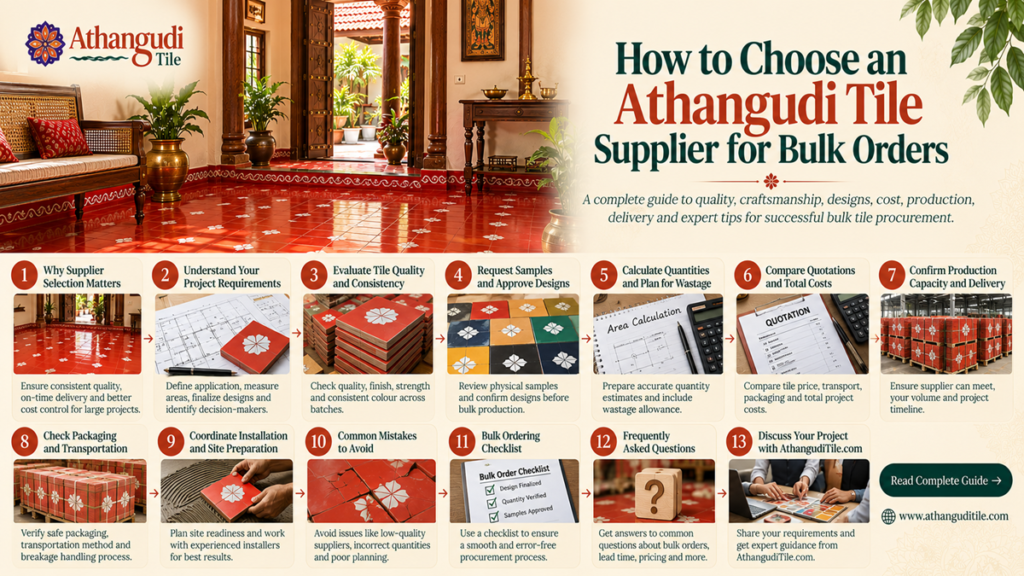
How to Choose an Athangudi Tile Supplier for Bulk Orders
Selecting the best tiles for your project If you are involved in a major build or construction then you will know how important it is to plan your project properly, particularly when it comes to designing and sourcing the materials that you will be using – such as flooring. Creating new residential properties, refurbishing property, installing a new boutique hotel or designing an interior are all projects that can be affected at every stage by finding the most appropriate tile supplier.Identification of Athangudi tiles Not only are these tiles known for their exclusive patterns and traditional craftsmanship, but also for their connection to South Indian architecture styles. They are fascinating dcor items, which can prove to be the best addition to your space, but they are not so easy to purchase for a huge project.Looking for Athangudi Tile Seller for bulk buying – Product verification, samples, quotes, deliveries, installations & agreement are a few factors. An Athangudi tile seller must be able to advise on these and also what all the things one should check before buying in bulk.Here’s a guide to evaluating suppliers for builders, architects, contractors, developers and land-owners, and gearing up to a future with a streamlined bulk-buying process. Why Supplier Selection Matters for Large Construction Projects In buying a tile for a single room, the consumer tends to look only for beauty, cost, and stock status. With a large project, other factors come into play because many rooms, floors, buildings, or phases of installation might rely on a single material choice.A poor buying decision can cause issues such as short quantities, being a higher cost, varied expectations of final appearance, or delay in dealing with missing order information.Your supply team can proactively mitigate these dangers with a deliberate choice of supplier. Maintaining consistency across the project For bigger projects, you might want the same pattern in various rooms, or other areas of the property. Speak to the supplier about ordering samples, matching between samples and the larger batch, and any standards of approval for samples.There may be variations in appearance between products. Request clarification from the supplier of what variations are usual for the tiles you are investigating, and how the supplied products will be tested in comparison to the approved sample. Coordinating procurement with construction schedules Purchase of products It should correspond to the development of the site and be timed to fit within the sequence of installation. Ordering products too late can be a pressure, ordering too early without appropriate storage can incur unnecessary handling risk.A sound procurement plan includes the demanded volume, order confirmation, production or availability, transport, inspection and installation date. Supporting better cost control The apparent lowest quoted tile price may not actually be the lowest overall project cost. Transportation, packaging, waste, preparation for installation, extended ordering, and delays may all add to the final budget.Looking at suppliers with the same project specifications can be a more consistent way of comparing the total requirements of a purchase rather than individual price points. 1. Understand Your Project Requirements Before Contacting Suppliers Look for a project brief before searching for an Athangudi tile wholesaler to place bulk orders. It enables suppliers to determine what quantity has to be supplied while getting quotations from different suppliers.Your brief should include the following information. Define the application Select the location for which you need to buy the tiles Think about the location where you would place the tiles. Various locations will have varying needs to look into if you require tiles for an interior living location, entry in a resort, an outdoor veranda, a business facility or a damp location. Discuss with the supplier/installer the way in which you will be using the product. Ensure that you select the right product in accordance with your exposure, required maintenance level and type of use. Beware of assuming that all Athangudi tile will fit any floor or it will be good for every other place. Estimate the required area Prepare room-by-room or zone-by-zone measurements. For a multi-storey building, maintain separate quantities for each floor and installation area. A simple schedule might include: This information gives the supplier a more useful basis for discussing the order. Establish design and specification requirements Determine what patterns, colours, measurements, edges and design arrangements are needed. If the project has got an interior design specification or even architectural plans, employ it to communicate the result. If multiple designs are needed, list each design separately instead of compiling them all into a single estimated amount. Identify the decision-makers Many projects have many people. The architect for the design, the contractor for installation and the commercial team for negotiations. Specify which party is authorized to approve samples, approve changes in quantity, and sign for the delivery and payment terms. This helps to prevent possible mixed messages in the course of an order. 2. Evaluate Tile Quality and Product Consistency You should have quality by the product and application. Product appearance is so, but not everything. Inquire with the vendor the properties of the tiles that have been selected and what technical information may require validation before the buy. Inspect visible characteristics When reviewing samples, examine: A visual inspection cannot establish every technical property. Where specifications such as slip resistance, moisture suitability, or strength are important, request appropriate supporting information rather than relying on appearance alone. Understand handmade variations Due to their handmade nature, these tiles are likely to have some differences. Buyers should be aware of what is considered standard variation and what is deemed a defect. Inquire of the supplier to provide an estimated range of appearance expected for the product, and whether more than one sample can be provided for evaluation. If the project involves large amounts of flooring, document the approval process so that you, the contractor, and the purchasing department can have the same understanding. Confirm product dimensions Never take a catalogue image or verbal description. Confirm the nominal sizes, tolerances and any installation requirements with the supplier. Length changes