
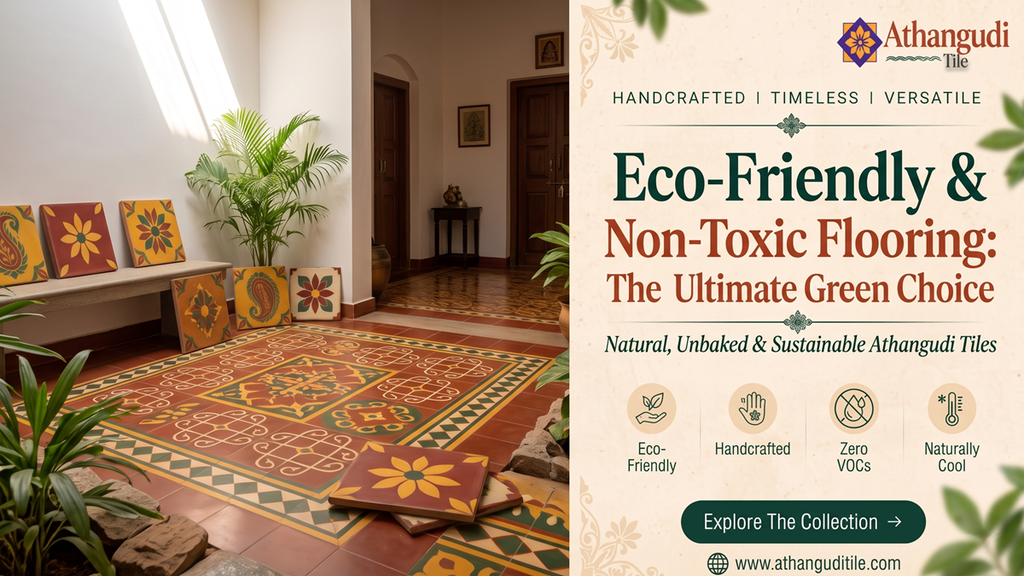
Modern architecture is shifting quickly toward sustainable living and healthy indoor spaces. Because of this, homeowners and architects actively seek eco-friendly flooring alternatives. Conscientious homeowners, civil engineers, and green architects now scrutinise building specifications for chemical toxicity and embodied carbon. Consequently, conventional floor finishes face sharp scrutiny.
Standard industrial finishes include vitrified tiles, synthetic vinyl, and petroleum-based epoxy coatings. However, these materials rely on petrochemical polymers that steadily release volatile organic compounds into enclosed rooms.
Handcrafted sustainable Athangudi tiles from the heritage Chettinad region of Tamil Nadu stand out as a time-tested, regenerative alternative for conscious architecture. Produced entirely by hand using earth-derived raw materials, zero thermal fuel combustion, and natural earth colourants, these artisanal tiles deliver a healthy, resilient, and non-toxic surface.
Whether you design an urban residence or a boutique resort, Athangudi flooring provides an ideal solution. In fact, it unites traditional craft with modern sustainable living.
The Ecological Dilemma of Modern Industrial Flooring
Flooring represents one of the largest continuous surface areas inside any built structure. Consequently, the material installed directly dictates indoor air purity, ambient thermal performance, and the ecological footprint of the project. Industrial floor finishes carry hidden environmental costs across their lifecycle:
- Intense Thermal Embodied Carbon: Standard vitrified and porcelain tiles must be fired inside giant tunnel kilns at temperatures ranging between 1,200°C and 1,400°C. Maintaining these temperatures requires around-the-clock consumption of fossil fuels like liquefied natural gas, coal, and petroleum coke, producing tons of atmospheric carbon dioxide.
- Persistent Indoor Chemical Off-Gassing: Manufacturers produce luxury vinyl tiles (LVT) and synthetic linoleum by blending polyvinyl chloride (PVC) with toxic plasticisers, phthalates, and chemical stabilisers. Over time, foot traffic and sunlight cause these polymers to off-gas chemical fumes. As a result, they degrade indoor air quality and trigger respiratory allergies.
- Severe Landfill Footprint: Industrial composite flooring and glazed ceramics never biodegrade naturally. Moreover, they cannot integrate safely back into the soil after removal. Crushed vitrified tiles remain non-reactive synthetic waste in landfills, while discarded synthetic polymers break down into persistent microplastics.
Handcrafted Athangudi vs. Industrial Flooring Options
| Evaluation Metric | Handcrafted Athangudi Tiles | Vitrified & Porcelain Ceramics | Luxury Vinyl (LVT) & PVC |
| Primary Raw Composition | Local river sand, unbaked grey cement, natural mineral oxides | Refined kaolin clay, feldspar, quartz, synthetic glazes | Polyvinyl chloride (PVC), phthalates, chemical binders |
| Manufacturing Heat | Zero Kiln Heat (ambient water-cured & sun-dried) | Continuous kiln firing at 1,200°C – 1,400°C | Fossil-fuel thermal polymer extrusion |
| Embodied Energy & Carbon | Exceptionally low; manual artisan fabrication | High carbon footprint from continuous fuel burn | High embodied carbon derived from petrochemical processing |
| Indoor VOC Profile | Zero VOCs (natural mineral matrix) | Negligible post-firing, but uses synthetic glazes | High potential for adhesive off-gassing and plasticiser vapours |
| Thermal Adaptation | Breathable micro-porosity for natural cooling | Dense, non-breathable; cold to the touch | Synthetic insulation; lacks natural mineral thermal inertia |
| End-of-Life Lifecycle | Inert mineral material; breaks down into natural rubble | Non-biodegradable; non-recyclable composite waste | Non-biodegradable polymer waste; generates microplastics |
1. Zero Kiln Firing: The Climate Power of Unbaked Cement Tiles
Minimising embodied carbon is the cornerstone of green building design. This metric measures all greenhouse gas emissions from raw material extraction, transport, and manufacturing. Industrial ceramics achieve structural rigidity by melting crystalline mineral matrices inside industrial furnaces, consuming massive amounts of fossil fuels.
Choosing authentic unbaked cement tiles eliminates thermal emissions at the source. The entire manufacturing process relies entirely on cold casting and ambient hydraulic crystallisation:
- No Fossil-Fuel Furnaces: First, artisans form the tiles cold on flat plate glass moulds without burning fuels. Artisans mix local sand, cement, and water, shaping each piece at room temperature.
- Potable Water Hydration: After demolding, the tiles cure submerged in water tanks for 8 to 15 days. This gentle water bath hardens the cement-sand mixture naturally. Therefore, the tiles gain peak strength through natural crystallisation instead of fuel-heavy heat.
- Clean Village Workshops: Chettinad production workshops operate without smokestacks, industrial exhaust, toxic slags, or fossil-fuel emissions, keeping rural communities clear of industrial smog.
2. Pure Earth Pigments: Certified Zero VOC Floor Tiles
Indoor air quality (IAQ) is a central parameter in contemporary architectural wellness and green rating assessments. Adhesives, synthetic paints, and plasticised floor tiles steadily release toxic vapours into living spaces. In enclosed, air-conditioned rooms, these vapours circulate through ventilation systems. Consequently, occupants often suffer from chronic headaches, allergies, and fatigue.
Athangudi tiles serve as authentic zero VOC floor tiles that safeguard residential air purity:
- Natural Mineral Oxides: The colours across every surface pattern are derived from inorganic earth oxides, such as iron oxides for mustard yellows and oxblood reds, cobalt for blues, and carbon for deep blacks. These mineral pigments do not break down into airborne chemical vapours.
- Natural Glass-Cast Sheen: Conventional tiles require synthetic liquid glazes containing heavy-metal fluxes. Athangudi tiles acquire their smooth satin finish solely from the surface tension of being cast against polished plate glass.
- Free of Synthetic Sealers: Homeowners maintain these floors using simple, natural damp mopping. Additionally, adding a few drops of vegetable oil cleans the floor without hazardous petrochemical polishes.
3. Safe Living Environments with Non-Toxic Floor Tiles
For households prioritising residential wellness, child-safe play areas, and barefoot comfort, installing certified non-toxic floor tiles is essential:
- Hypoallergenic Surfaces: The dense, cured mineral surface does not harbour dust mites, pet dander, or mould spores, fostering clean ambient air for family members with allergies or asthma.
- Child and Pet Safe: Artisans never apply synthetic chemical coatings, lead glazes, or petroleum waxes. Because of this, crawling infants and resting pets stay completely safe from toxic chemicals.
- Natural Barefoot Tactility: Walking on natural cement tiles offers grounding tactile feedback, free of the plastic texture of vinyl or the artificial, glossy chill of machine porcelain.
4. Passive Microclimatic Cooling for Green Building Flooring
In tropical, subtropical, and warm temperate regions, passive cooling design is vital for reducing reliance on mechanical air conditioning. Dense industrial vitrified tiles trap daytime room heat. In addition, they remain clammy in high humidity, forcing air conditioners to run much longer.
Integrating Athangudi tiles into green building flooring plans optimises passive thermodynamic performance:
- Micro-Porous Thermal Dissipation: The unbaked cement and local river sand composition maintain subtle micro-porosity. This breathable structure absorbs indoor heat and slowly dissipates it into the subfloor slab. As a result, the tiles stay delightfully cool underfoot during hot afternoons.
- Lowering Cooling Energy Loads: By moderating floor-level room microclimates, living areas feel naturally cooler, allowing occupants to reduce air-conditioning runtimes and cut household electricity consumption.
- Comfortable Winter Balance: In cooler seasons, natural cement tiles adapt smoothly to room ambient temperatures without holding the bitter chill characteristic of glazed porcelain.
5. Localised Artisanal Economy and Low-Waste Lifecycle
A truly sustainable building product must account for human ethics, regional sourcing, and material lifecycles alongside carbon metrics:
- Regionally Sourced River Sand: Athangudi artisans utilise river sand sourced from local waterways and minimal grey cement, cutting down long-distance freight emissions.
- Preserving Living Cultural Heritage: Handmade tile production supports multigenerational artisan families across rural Tamil Nadu. Furthermore, it preserves a zero-waste heritage craft against automated factory lines.
- Negligible Waste Generation: Artisans measure and mix colour oxides and mortar in precise, individual batches. Consequently, the process produces zero chemical runoff and avoids plastic packaging waste.
Step-by-Step: The Cold-Cured Artisan Fabrication Process
- The Glass Casting Base: Artisans begin with a sheet of polished plate glass on a workbench. Through simple surface tension, the smooth glass imparts a satin sheen. This method eliminates chemical glazes and machine polishers.
- Pouring the Mineral Matrix: A master artisan aligns a handcrafted metal stencil on the glass, using a ladle to pour a liquid mixture of white cement and natural mineral oxides into each compartment.
- Locking Pigments with Local Sand: Once the master artisan pours the pattern, they lift the stencil straight up. Next, the worker sprinkles a dry blend of local river sand and cement over the wet oxides. This absorbs excess moisture and locks in crisp design lines.
- Structural Mortar Tamping: Then, the artisan tamps down a firm backing layer of sand and cement. This builds a durable structural tile body measuring 15 mm to 20 mm thick.
- Slow Water-Tank Crystallisation: Finally, workers peel the dried tiles from the glass plates and submerge them in water tanks for 8 to 15 days. This natural water curing hardens the cement without kiln heat. Because of this hydration, the tiles gain high compressive strength and stay cool underfoot.
Green Home Installation and Eco-Friendly Maintenance
To maintain the low-carbon, non-toxic integrity of an Athangudi floor throughout its lifespan, avoid synthetic adhesives and petroleum cleansers during installation and daily care:
- Traditional Lime-Sand Mortar Bedding: Lay tiles on a conventional sand-and-cement mortar bed rather than petroleum-based polymer thin-sets. A 1:4 cement-sand mix provides a stable bed that allows the mason to level each handcrafted tile flush with adjacent pieces.
- Tight Hairline Joints: Install tiles with hairline gaps (1 mm to 1.5 mm). Fill these narrow joints using a natural liquid cement slurry tinted with matching mineral oxides, avoiding synthetic epoxy grouts.
- Gentle Water Mopping: Routine cleaning requires only clear water. Avoid chemical detergents, commercial bleaches, or hydrochloric floor washes, which corrode natural mineral binders.
- Organic Vegetable Oil Nourishment: Every month or two, add 3 to 4 drops of cold-pressed coconut or linseed oil to your mop water. This natural plant oil nourishes the cement, seals micropores organically, and builds a protective, chemical-free patina over decades of barefoot use.
Frequently Asked Questions
How do Athangudi tiles contribute to green building rating systems like LEED, WELL, and IGBC?
Athangudi tiles contribute directly toward several sustainable certification criteria. Their zero-VOC profile aligns with Indoor Environmental Quality (IEQ) standards for low-emitting interior finishes. Additionally, their regional extraction and production minimise transportation carbon, while their zero-kiln, water-cured fabrication reduces overall lifecycle embodied energy.
Are Athangudi tiles biodegradable at end-of-life?
Because they consist exclusively of river sand, cured cement, and natural mineral oxides, discarded or crushed tiles act as inert stone aggregate. They do not release microplastics, toxins, or petrochemical compounds into landfills, and crushed tile material can be repurposed as inert aggregate for structural sub-bases or landscaping.
How do Athangudi tiles maintain their surface lustre without synthetic waxes or chemical sealers?
The initial lustre is achieved purely from casting against smooth plate glass. Over time, daily walking and light damp-mopping with occasional traces of vegetable oil continue to buff and harden the natural cement surface, creating a rich, organic patina.
Can sustainable Athangudi tiles be installed in high-humidity exterior courtyards?
Yes. Their water-cured cement matrix and UV-resistant inorganic mineral oxides perform reliably in semi-covered outdoor spaces, verandahs, and internal courtyards. When laid with proper surface slopes to shed standing rainwater, their natural slip-resistance provides a secure surface under tropical conditions.