
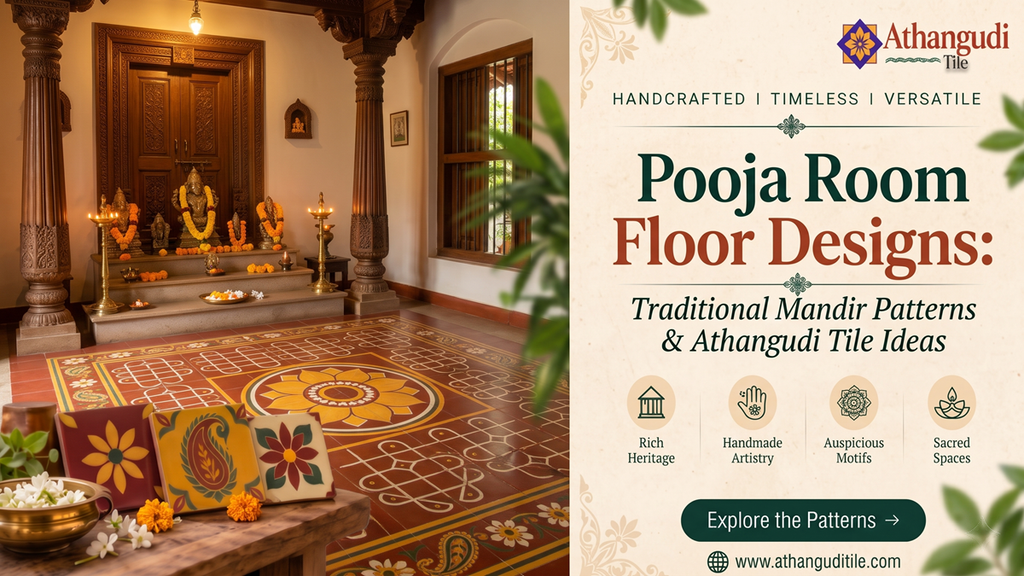
In conventional Indian home design, a pooja room floor design (or mandir) is never a simple decoration. Instead, it serves as the spiritual heart of the home. This sacred space hosts morning prayers, quiet meditation, and illuminated oil lamps. While many homeowners invest in ornate teakwood doors, brass bells, and carved stone pedestals, the floor beneath your feet forms the true foundation of your spiritual journey.
The texture and temperature of your prayer room floor directly shape your daily worship. Furthermore, the floor material controls how light reflects through the space, creating a soothing sanctuary.
Authentic Athangudi tiles offer a rare combination of grounding tradition, artisanal beauty, and long-term durability. Originating in the historic Chettinad region of Tamil Nadu’s Sivaganga district, these handcrafted tiles have graced ancestral mansions and temple halls for generations.
Whether you are designing an expansive prayer hall in a villa or a compact mandir niche in a modern apartment, this guide explains their spiritual symbolism, artisan casting methods, layout ideas, and care rituals.
Creating a Calming Foundation for Daily Worship
The texture and temperature of your prayer room floor directly shape your daily worship. Furthermore, the floor material controls how light reflects through the space, creating a soothing sanctuary.
Authentic Athangudi tiles offer a rare combination of grounding tradition, artisanal beauty, and long-term durability. Originating in the historic Chettinad region of Tamil Nadu’s Sivaganga district, these handcrafted tiles have graced ancestral mansions and temple halls for generations.
Whether you are designing an expansive prayer hall in a villa or a compact mandir niche in a modern apartment, this guide explains their spiritual symbolism, artisan casting methods, layout ideas, and care rituals.
The Spiritual Significance of Sacred Flooring in Indian Architecture
In classical Vastu Shastra and old Indian urban design, each architectural plane radiates a directive towards mental stillness and flow of energy. Classical Vastu Shastra teaches that every architectural plane guides energy flow and mental stillness. Sacred niches demand thoughtful choices because worshippers maintain direct, barefoot contact with the floor throughout their prayers.
Worshippers sit on mats, bow before deities, and walk barefoot across this surface daily. Consequently, synthetic, ice-cold glazed ceramics and chemically washed vitrified tiles feel far too sterile.
Authentic Athangudi tiles rely solely on natural earth materials:
- Ultra-fine local river sand
- Unbaked grey cement
- Pure mineral colour oxides
Because of this natural composition, your feet touch genuine minerals that breathe and adapt to room temperatures.
During hot summer afternoons, these unbaked tiles remain naturally cool against bare skin. Conversely, during winter mornings, they never develop the harsh, icy chill typical of factory-made glazed ceramics. As a result, your body stays relaxed, allowing you to focus deeply on meditation and prayer.
In addition, the silky, matte surface of glass-cast Athangudi tiles softens the light from brass lamps (diyas and kuthuvilakku). Unlike commercial tiles, they eliminate harsh, distracting glare. The soft, gentle reflection of flame against the tile face creates a serene, temple-like ambience.
In addition, the matte and non-reflective glass-cast surface of Athangudi tiles acts as a medium to soften the flickering warm glow of brass oil lamps (diyas and kuthuvilakku) without any offensive glow that hits the glaze ceramics commercially. A very delicate and warm reflection of lamps on the Athangudi surface gives the prayer room a semi-temple ambience.
Auspicious Motifs and Sacred Symbolism in Athangudi Art
All of the motifs cast into an Athangudi metal stencil contain centuries of deep philosophical and spiritual significance. Incorporating these intricate auspicious floor tile patterns not only brings to life your sacred space but turns your pooja room into a curated altar of blessings.
1. The Lotus Medallion (Padma)
Indian spiritual traditions revere the sacred lotus as the ultimate symbol of purity, detachment, and spiritual awakening. Just as the lotus blooms untouched by muddy waters, this symbol reminds seekers to rise above daily distractions.
Custom Athangudi lotus medallions typically combine 4, 8, or 16 symmetrical tile segments. Homeowners traditionally position this medallion directly in front of the altar pedestal (peeta). Consequently, it creates a dedicated sacred focal point for offering flower petals or placing your prayer mat (asanam).
2. The Sacred Mango Motif (Manga / Paisley / Kalka)
The paisley teardrop, known locally throughout South India as the Manga motif, is a stylised abstraction of the raw, ripening mango fruit. A symbol of Lord Ganesha and Goddess Lakshmi, the mango motif is considered very auspicious, bringing wealth and joy, bountiful harvests and prosperity.
The teardrop paisley, known across South India as the Manga motif, represents the raw, ripening mango fruit. In Hindu tradition, this form connects directly with Lord Ganesha and Goddess Lakshmi. Therefore, families value it as an auspicious sign of wealth, joy, and prosperity.
While artisans frequently use paisley in temple jewellery and handwoven silks, it also brings dynamic rhythm to architectural spaces. For example, paisley border strips look stunning across prayer room thresholds or as framing borders around floor mats.
3. Kolam and Yantra-Inspired Geometric Grids
Geometric Athangudi designs establish visual order and remove mental clutter. In fact, many believe these symmetric patterns resonate with spiritual energy. Interlocking geometric lines, eight-pointed stars (Ashta Lakshmi), and diamond grids build a space of quiet reverence. Thus, they provide an ideal environment for rhythmic chanting, japa, and mindful breathing.
4. Consecrated Perimeter Borders (Kodi)
Most of the traditional Chettinad architecture never takes a floor for granted. Extending the creeper florals (kodi) in a repeating pattern, geometrical zigzag and leaf run in a ready to wall the magic wall. In the sacred world of spirituality, these boundary lines define holy gates for the body and soul to cross.
Handcrafted with Devotion: The Glass-Cast Artisan Process
The process of manufacturing these tiles will explain how they have come to be considered living artworks rather than throwaway building products. As opposed to machine-stamped industrial ceramics which are fired in automated kilns, installing handmade cement tiles for prayer room sanctums introduces a living, breathing craft shaped with devotion:
- The Handcrafted Metal Stencil: The artisan first places a brass or iron stencil flat onto a smooth sheet of plate glass. This glass base gives each tile its smooth, silky finish without synthetic glazes or rotary machine polishing.
- Pouring the Mineral Slurry: Next, the artisan uses a curved ladle to pour liquid white cement blended with natural mineral oxides into each stencil section. The traditional pooja palette features turmeric yellow, oxblood red, cobalt blue, lamp black, and forest green.
- Locking the Mineral Oxides: Once the pattern fills, the artisan carefully lifts the metal stencil straight up. They immediately sift a dry blend of sieved river sand and grey cement over the moist oxides to lock in crisp pattern lines.
- Building the Structural Base: Workers then pack a moist cement-sand mortar over the design layer, tamping it down to build a solid 15 mm to 20 mm tile base.
- Slow Water-Tank Curing: After sun-drying for a few days, workers separate the tiles from the glass plates. They submerge the tiles in fresh water tanks for 8 to 15 days. This natural water immersion cures the cement without kiln heat, delivering crack resistance, compressive strength, and a naturally cool feel.
5 Sacred Layout Concepts for Modern Homes and Mandirs
Every house has its own distinct design, whether it’s a clearly defined puja room or a small corner of the house dedicated to prayer. When planning traditional mandir flooring, here are 5 useful concepts to arrange your Athangudi tiles:
Concept 1 – The “Padma” Centre Medallion Under the Altar Peeta
Create an eye-catching focal point in square or rectangular prayer rooms. Position a circular or square lotus medallion (comprising 8 or 16 tiles) directly in front of the altar. Frame this feature with plain terracotta-red or warm ivory tiles. This design draws immediate attention toward the sanctum.
Concept 2 – The Symmetrical Chanting & Meditation “Tile Carpet”
If you have a spacious pooja room for family prayers and bhajans, design a tile carpet. Lay an interlocking geometric pattern across the central floor area. Next, enclose the pattern with 6 to 10 rows of matching border tiles. This creates a dedicated, comfortable meditation zone.
Concept 3 – The Auspicious Entryway Threshold Runner
In South Indian construction, the doorway (denoted by the threshold “vaapadi”) is considered the passageway warded over by deities. A line of custom ‘manga’ border tiles, depicted here as a row of petite paisley, is laid down vertically through the opening immediately below teakwood carvings. Extend this border in a skirt tiling right around the base of inside walls, to mark off the sacred space from hallways or the living room.
Concept 4 – Classic Turmeric & Oxblood Checkerboard Alcove
In these niches, corridor corners or cupboards for a wall-mounted mandir, elaborate large pattern tiles can sometimes feel overwhelming in the constrained ground footprint. Rather, create a cheerfully alternating checkerboard pattern of plain warm turmeric-yellow Athangudi tiles with deep oxblood red.
This timeless hue combination is inspired by temple corridor walls created by flickering lamp light, and lends even the smallest alcove true heritage warmth.
Concept 5 – Traditional Kolam Tile with Brass Inlay Transition
For this modern-vintage home, combine ethnic artisanal skills with clean modern lines. Match black-and-white or cream-and-terracotta geometric Athangudi tiles in monochrome with slim polished brass inlay strips cast into the joints.
Accentuate the handmade cement tile’s patina when the reflective brass lines are installed around the idol podium, combining traditional design with modern interior aesthetics.
Pattern & Placement Matrix: Choosing the Right Motif
Selecting authentic Chettinad pooja room tiles requires balancing sacred geometry, room dimensions, natural light, and devotional furniture:
| Motif Category | Spiritual Symbolism | Visual Impression | Ideal Placement | Complementary Accents & Woodwork |
| Floral & Lotus (Padma) | Purity, spiritual enlightenment, non-attachment, divine grace | Soft, sacred, welcoming, regal | Central altar zone, directly beneath deity pedestals | Carved teak altars, rosewood mandirs, marigold garlands |
| Paisley Motif (Manga) | Prosperity, fertility, auspicious beginnings, good fortune | Fluid, ornate, flowing, royal | Doorway thresholds, framing borders, prayer runners | Heavy brass oil lamps (kuthuvilakku), hanging bells |
| Geometric Grids | Balance, harmony, cosmic order, mental focus | Structured, calm, serene, architectural | Full room floor for meditation and prayer spaces | Polished black granite plinths, woven cane seating |
| Decorative Borders | Sacred delineation, spiritual protection, framing | Crisp, defining, protective, elegant | Perimeter trims, step risers, mandir base skirting | Terracotta floor bases, polished brass transition strips |
Everyday Care, Spill Management, and Preservation Rituals
Sacred offerings drench the temple floors every day; dripping from the lamps of clarified butter (ghee), sesame oil, holy water (theertham), incense ash (vibhuti), and completely natural red vermilion (kumkum).
Modern ceramic glazed tile is a protective chemical glass shield barrier; Athangudi tile is a naturally mineral-based cement tile, carrying the experience of the years of a house buried within; they acquire, over time, an intense shining patina. For your tiles to survive over the years intact and without dulling stains, you can follow these steps to protect their glow:
Managing Lamp Oil and Ghee Spills
Managing Lamp Oil and Ghee Spills
Because natural cement is slightly porous, standing oil will seep into the top layer if left unattended. Keep a small brass bowl of dry wheat flour, fuller’s earth (multani mitti), or fine sawdust near your mandir.
When oil drips from a lamp, sprinkle the dry powder over the puddle to draw out the grease. Afterwards, wipe the spot with a dry cotton cloth. In addition, place small brass or terracotta coasters beneath large lamps to catch drips.
Handling Turmeric, Kumkum, and Chandan
Dry pooja powders will not stain cured Athangudi tiles if you sweep them up at the end of each day. However, damp turmeric paste or wet vermilion can bind with cement minerals if left for days. Keep a damp microfiber cloth near the altar table to wipe away wet spills during morning rituals.
The Golden Rule: Avoid Harsh Acids and Bleaches
Never clean your Athangudi pooja floor with store-bought chemical detergents, bleach, or acidic toilet cleaners. Acids rapidly dissolve the cement binder and strip the natural mineral pigments. Plain warm water is all you need for daily maintenance.
The Traditional Plant-Oil Polishing Secret
Chettinad housekeepers never used synthetic polyurethane coats or chemical floor waxes. Instead, they relied on a simple plant-based method:
Once or twice a month, add 3 to 4 drops of pure coconut oil or cold-pressed linseed oil to your mop water. As you mop, this minute amount of natural oil feeds the cement matrix and seals tiny pores. Over time, regular barefoot walking buffs the floor, developing a deep, protective patina.
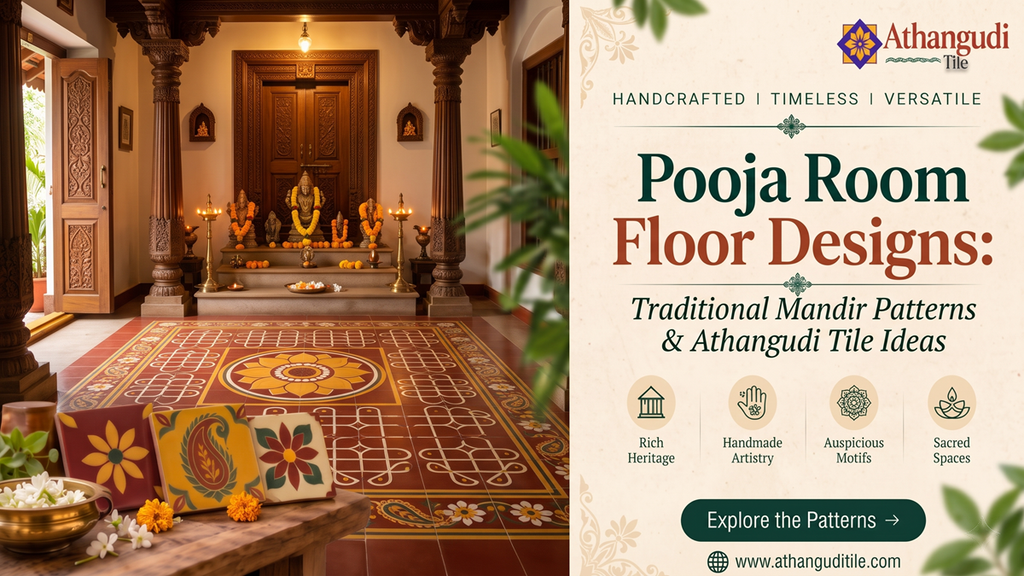
Technical Specifications & Installation Best Practices
Proper substrate preparation and joint detailing are essential to avoid any moisture issues or trip hazards when installing authentic handmade tiles in a holy space:
- Tile Dimensions: Original Athangudi floor tiles are cast in standard sizes 8″ x 8″ (200 x 200 mm) or 10″ x 10″ (250 x 250 mm) with a total depth of 15 mm – 20 mm. Border bands and skirting strips can be produced in matching smaller widths.
- Traditional Wet Mortar Bed: Because each tile is cast by hand, individual pieces show slight variations in thickness. Therefore, lay them over a wet mortar bed (1:4 cement-sand mix) rather than chemical adhesives. This pliable bed allows the mason to level every tile perfectly flush with adjacent pieces.
- Hairline Joints: Install Athangudi tiles with tight hairline joints (1 mm to 1.5 mm). Avoid wide grout gaps or epoxy resins. Instead, fill these narrow seams with a liquid cement slurry tinted with matching mineral oxides, wiping the excess off with moist cotton.
- Rice Husk Buffing: After the joint slurry dries completely, spread a thin layer of dry rice husk (or fine sawdust) mixed with a few drops of coconut oil across the floor. As masons sweep and buff the husk across the surface, it cleans off dried cement residue and leaves a lustrous, satin finish.
Frequently Asked Questions
Are Athangudi cement tiles cold to sit on during meditation?
No. Artisans cure these tiles slowly in water tanks rather than baking them in industrial kilns. Consequently, they maintain a balanced, pleasant room temperature. They never feel uncomfortably cold like vitrified ceramic tiles during prolonged meditation.
Are Athangudi tiles slippery for elders or young children?
No. Casting against plate glass produces a smooth finish, but natural cement retains an organic micro-texture. This natural texture offers superior grip compared to high-gloss vitrified tiles or polished marble, ensuring a safe surface for barefoot walking.
Are Athangudi tiles slippery for elderly family members or children?
No. Natural cement, which has a smooth profile due to casting on plate glass, still has a natural organic, micro-textured surface which is more slip-resistant than polished vitrified tiles or glazed marble and offers a secure grip for walking barefoot, as seniors would need for daily prayer.
What if I want to get colour match on my home mandir woodwork?
Yes. As each Athangudi tile is poured into a hand-placed metal mould, we offer our customers the ability to custom-mix particular mineral oxide colours. If you require a dark burgundy to match a mahogany veneer interior, a tender ochre to go with the natural grain of a teak veneer, or even a simple charcoal and off-white grid, it can be done.
Can Athangudi tile last longer than pooja room granite or marble?
Correctly installed and maintained with gentle cleaning techniques using no harsh acids, real Athangudi floors will last a hundred years or more. Machine-printed tiles can crack, fade, and peel away, whereas natural cement tiles mature, sink, and gain more depth of colour and character over many decades of use.