
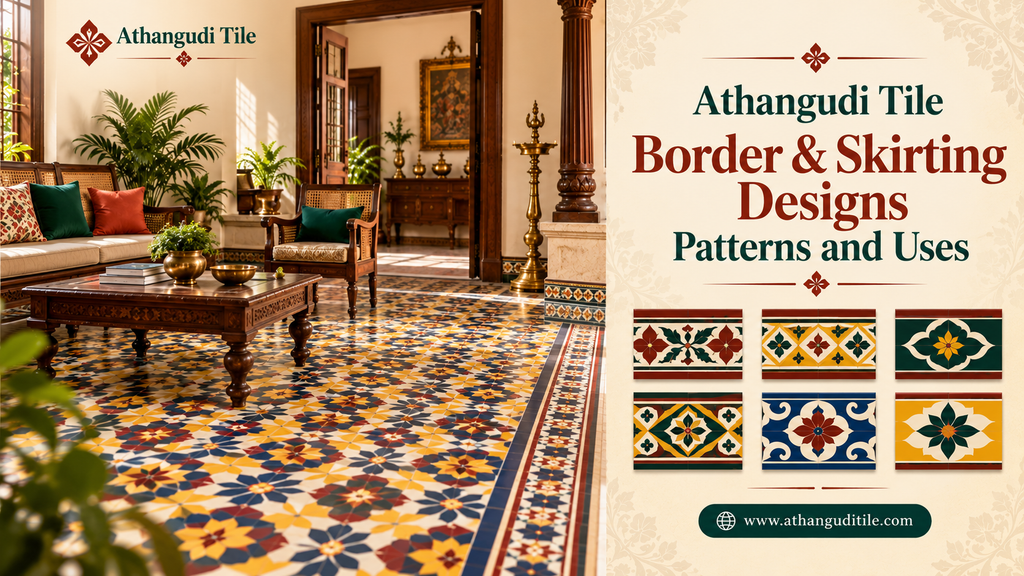
Your floor isn’t the only element to consider when tiling. Borders have decorative implications for a floor, as well as skirting at the junction of the wall and flooring can help to create a sense of finish.
Athangudi tile border and skirting designs can allow you to match the craftsmanship of other styles of interior design. Be it a residential, commercial, hospitality, or renovation project, appropriate patterns are easy to match.
They can feature decorative borders around a floor, or skirting along the edge – subtle details that add visual appeal to a room. Learning about the different types of skirting available, where it can be used, and the important considerations when choosing it can help you decide more easily.
“Details make the difference. Beautiful tile borders and skirting bring elegance, character, and a refined finish to every space.”
1. What Makes Athangudi Tile Border and Skirting Designs Special?
Athangudi tiles are associated with Chettinad craftsmanship of Tamil Nadu. Because of the attractive features they possess, these tiles are used as flooring material for projects that want to have a traditional touch with special, distinct details.
Use decorative tile borders to frame the perimeter of a floor, separate two areas, or highlight a specific section. What Is a Tile Skirting? A tile skirting is a strip of tile used to trim at the base of a wall where it meets the floor.
Picking a border and skirting jointly helps you to bring in the layout of the main flooring, without making the pattern appear improper. Achieve this by choosing border and skirting designs that complement your tile layout, colour scheme, size, and desired look.
2. Popular Athangudi Tile Border Designs and Patterns
Browsing the tile border patterns can be a good starting point if decorative flooring is on your list. As well as a break in a pattern, border tiles can have a contrasting pattern or a complementary pattern.
Some design options to look at:
– Geometric patterns: Reoccurring patterns can be formal-looking and complement a geometric floor.
– Contrast corridors: Different colours can separate the edge of a surface from its main pattern.
– Traditional patterns: Motifs can be used to highlight the Athangudi flooring, inspired by heritage.
– A light patterned border could encircle the floor without interfering with the decorated centre.
– Borders in combination: Using motifs and colours taken from the main flooring for borders to create a coherence.
Consider how the Athangudi tile border design will look across your entire floor, rather than judging it as a single tile.Repetition, gaps, and alignment can make a difference.
3. How Tile Borders Enhance Different Spaces
Choose the right edge design to create a neat border that highlights the flooring.
Borders are great for use in the living areas as they complete the centre pattern in the flooring. Borders can also serve as a link to join together the rooms in the hallways and entrances. Use borders to divide a room into separate areas and conceal uneven or untidy transitions where needed.
Add an accent border to enhance commercial interiors, hospitality spaces, and other projects while complementing the overall design theme.
A dramatic border can give a bit of wow factor to a more plain covering of flooring, but if you have quite a busy tiled area then a more subtle border might work better.
Before you select a scheme, consider the dimensions of the room, your existing finishes, lighting and how the other areas of your flooring will connect.
“From traditional patterns to decorative borders, Athangudi tiles bring timeless craftsmanship and distinctive beauty to your flooring.”
4. Athangudi Tile Skirting: Purpose and Design Options
Skirting is a feature of the overall design that you can add to your flooring design that might be more significant to you than it may first appear to be. Install skirting along the bottom of a wall to create a clear transition between the wall and the floor.
Athangudi tile skirting – matching: It can be coordinated with the flooring around it if the colours and patterns are a good match for the flooring.
Consider these choices when choosing the skirting:
– Colour/ design to coordinate your skirting: Matching skirting: Use a matching design/colour of paint so that the colours are continuous to the floor.
– Change the skirting: Paint a different colour to draw a clearer line between your wall and floor.
– Simple skirting: Keep it simple if the flooring design is decorative.
–Combinations with decorative plinths: Opt for details that are in harmony with the border.
Choose the best option by considering the main flooring, wall coverings, and the overall look you want to create. Confirm the tiling you want are relevant and comprehensive with your supplier.
5. How to Coordinate Border and Skirting Tiles
Borders and skirting are most effective when considered as part of one design plan.
Begin by establishing the main feature of the floor pattern and the prevailing colours. The border may underline one of the colours, provide a contrasting one, or serve as a frame for the central pattern.
Use a border to create a smooth transition between the skirting and the wall. You can choose a different design from the floor border, as a more neutral colour may create a better visual balance.
For instance, a detailed floor with an elaborate border can appear more in harmony when installed with simple skirting. In contrast, a basic floor can work well with a prominent border and a matching skirting design.
Before completing the combination, benchmark the available samples with the proposed layout. This will give you a fair idea of how the elements will appear with each other.
6. Choosing the Right Designs for Different Applications
Exactly the best form of border and skirting for tile is something that is based on the specific task.
Consider flooring as you would furniture, wall finishes, and adjacent spaces in domestic design. In commercial schemes, the flooring choice should be compatible with the interior scheme and operational requirements of the site.
A common theme for doorways and hallways is having a border pattern that wraps around the walls from one room to the next. Decorative mat borders are better in a large interior, maybe a simpler border in a smaller interior.
Consider how you will use the area, how much water it may encounter, how often you will clean it, and whether the tiles suit its intended purpose. Before you buy, ask the company for the correct model and see how to install it correctly.
7. Installation Considerations for Border and Skirting Tiles
You might have a fantastic-looking design, but if the layout is not well-planned, it can completely ruin it. To install is to measure, position, calculate the corners, and connect the parts of the floor.
Layout and mark out your area prior to installation. Mark the starting and ending position of your border, and determine how your pattern will flow around doorways, corners and between rooms.
If placing around edges of walls, corners, and finishing. Describe cut requirements and how it will line up with the installer before installation.
To begin, prep the area and use the proper type of products. Obey the supplier’s instructions on how to finish your installation and treat it in order to guarantee the best outcome.
8. Maintenance Tips for Border and Skirting Tiles
Proper maintenance also helps to preserve the attractive features of flooring as well as ensure cleanliness. The best way to maintain the flooring well will definitely depend on the type of ceramic tiles, surface, and advice from your manufacturer.
Common Safety Measures to Consider
– Regularly vacuum all loose soil or free particles.
– Use only cleaning products that the manufacturer approves for your tiles.- Now exists, wipe up messes as they happen: your choice method.
– Avoid harsh chemicals and abrasive cleaners unless the manufacturer explicitly approves them for your tiles.
– Look along the edge and joint for evidence of damage or abrasion.
Examine the borders of the tiles that potentially have dust. If you are noticing stained tiles, surface damage, or changes in the tile’s composition of color, speak to your supplier rather than scrubbing your tile hard to get the stains out.
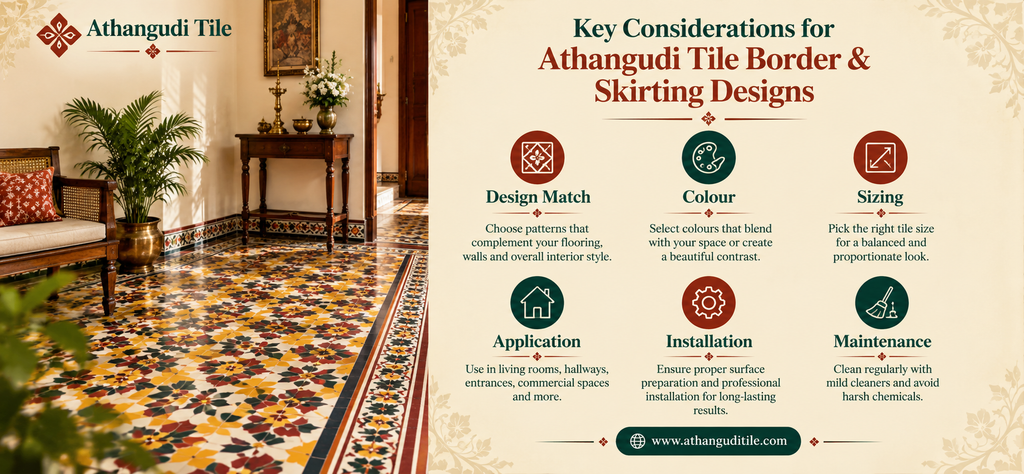
9. What to Consider Before Choosing Border and Skirting Designs
Check the project requirements before your final decision and compare all the possibilities you have.
Consider these factors:
– Design match: Does the border coordinate with the main flooring?
– Colour: Do the border and skirting complement the surrounding finishes?
– Sizing: Will the design repeat uniformly throughout?
– Application: Will the product, once used, be appropriate to the application environment?
– Installation: Have you identified the layout, cutting, and finishing requirements?
– Maintenance: Can you maintain the tiles easily using suitable cleaning and care techniques?
Request samples or layout instructions when you can. You understand a design better when you see it in person instead of just looking at a picture.
10. Explore Athangudi Tile Border and Skirting Options
Borders and skirting provide an ideal opportunity to finish off a flooring design. With everything from classic patterns to coordinating yet simpler finishes, there’s sure to be a match to suit any main tile design.
Before you decide on the final design, think about the pattern of the flooring, the colours around it, the size, and the practicality.
Learn more about Athangudi Tiles Border & Skirting with our range of design options. If you know what you’re doing or have some experience, you can talk with the supplier to figure out which design will work best for the project.
If you plan them right, tile borders and skirting can bring a nice decorative touch and a neat, finished look to the floor.
Frequently Asked Questions
1. What are Athangudi tile border designs?
Artisans create Athangudi tile border designs as decorative patterns that run around or between flooring areas, enhancing both the tiles and the overall space.
2. What is the point of tile skirting?
Tile skirting provides a polished transition between the flooring surface and the wall. It can also assist in safeguarding the bottom of the wall from regular wear and tear.
3. Can the border and skirting of a tile be different?
Yes. As long as it matches the main flooring and finishes to any other floors around it, they can have whatever patterns or colours they want.
4. How do I choose the right tile border design?
Think about the primary floor pattern, spacing, colour palette, and application. Cross-reference samples and arrangements before you decide.
5. How should I take care of my Athangudi tile skirting?
Select cleaning supplies and techniques compatible with your tiles. Adhere to the supplier’s instructions and steer clear of chemicals and/or abrasive tools unless explicitly approved.
6. What types of Athangudi tile border and skirting are available to view?
Check out Border & Skirting’s service page to learn more about the service offering and contact the supplier for additional information on available designs.