

The Athangudi tiles can be recognised by their handcrafted look, unique and vibrant patterns, colour and South Indian traditional feel. They have gained huge popularity among homeowners, architects and interior designers to add touch of character and artfulness to today’s contemporary spaces.
But what about the history of the Athangudi tiles and how did this method of traditional tiles come to be used in modern interiors?
In this guide, we take a quick look at the history of Athangudi tiles, how they are traditionally made, typical patterns and colours, their uses, advantages and how to incorporate them into contemporary Indian homes.
“Athangudi tiles bring together traditional South Indian craftsmanship, vibrant patterns, and timeless colours, adding character, artistry, and heritage to contemporary Indian interiors.”
What Are Athangudi Tiles?
Athangudi tiles are all handmade decorative tiles from the Athangudi region of Tamil Nadu. The design characteristics of Athangudi tiles include bright colors, geometric design, floral design and their handcrafted texture.
One of the things which make it different from other factory made tiles is that in Athangudi tiles factory, before the processes of moulding, colouring, curing, finishing and so on, every tile goes through a few steps of preparation.
As the tiles are handcrafted by the artisans, Athangudi tiles are not perfectly uniform. There could be some slight variations of colour, pattern or surface feel of the tiles.
Presently Athangudi tiles are being utilized for flooring, wall cladding, bathrooms, kitchen, balcony, the entrance staircase, the courtyard and other interior spaces.
The History of Athangudi Tiles
Athangudi tiles have a long history that is attached to the Chettinad region’s built environment and associated design culture in Tamil Nadu.
This style is often defined by highly decorative interiors, surfacing, courtyards, vibrant, intricate materials. The decorative handmade tiles became part of this style and their design.
Athangudi tiles were created as an aesthetic yet functional floor covering material to add colour and pattern to buildings. They were thought of as decorative and used in traditional houses and other locations where visual detail was paramount.
Through the years, the craftsmanship of these tiles has advanced, but still remained rooted in traditional techniques.
From this point on, “Athangudi” became the label that became linked to this kind of handmade flooring tile and as a result was distinguished from the standard mass marketed type of flooring tile.
Traditional Athangudi Tile Craftsmanship
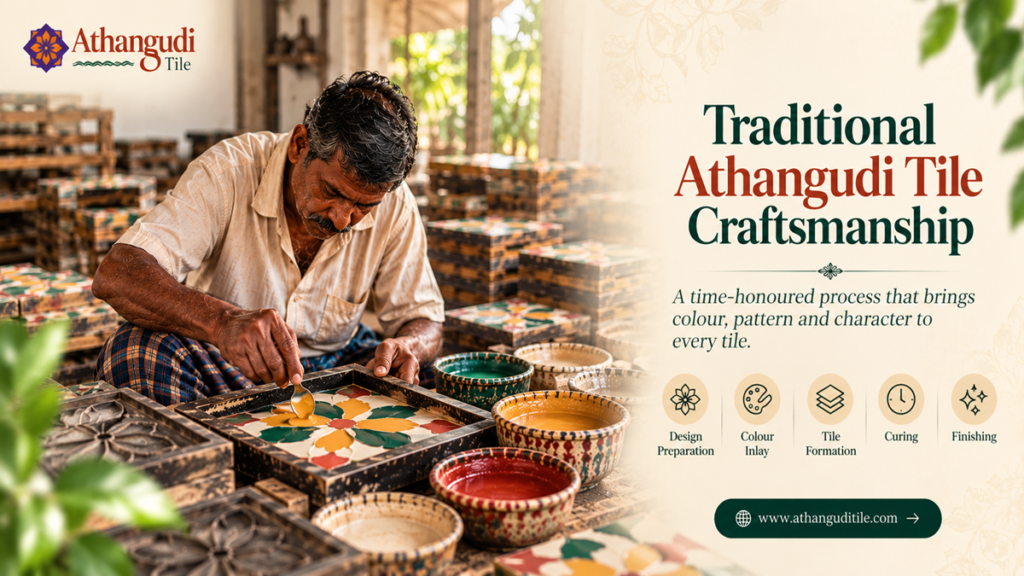
Handmade manufacturing of Athangudi tiles is one of the key features.
A conventional process of making production could be constructing a pattern as a knock up with a mould or design outline. Various colours are meticulously inserted into specific locations of the design prior to the body of the tile being created.
This stage has to be precise since how the colours and patterns are laid will influence the end result.
Once the shape and tile material are formed, the tile then is cured and finished.
The old-fashioned method of making Athangudi tiles is one that requires some patience and skill.
Why Handmade Production Matters
The fact that these tiles are handmade gives Athangudi tiles a character that is hard to come by with full automation.
There may be some slight variations in each tile in some of these details, such as colour vibrancy, pattern positioning and surface appearance.
These differences are a characteristic of our hand-made product and can give a more natural, artistic look when laying the tiles over a wider surface.
Athangudi Tile Designs
Design is one of the most recognisable features of Athangudi tiles. Traditional Athangudi tile designs commonly feature:
- Geometric patterns
- Floral motifs
- Repeating shapes
- Borders
- Symmetrical designs
- Traditional Indian-inspired patterns
- Multicolour combinations
- Decorative central motifs
Some patterns have a bold appearance, while others use smaller details and softer colour combinations. This variety makes Athangudi tiles suitable for different interior styles.
Popular Athangudi Tile Colours
Colour plays an important role in the appearance of Athangudi tiles. Traditional and contemporary designs can include combinations of colours such as:
- Red
- Yellow
- Green
- Blue
- White
- Cream
- Black
- Brown
- Terracotta-inspired shades
The right colour combination can change the overall atmosphere of a room. For example, brighter patterns can become a focal point in a neutral room, while softer combinations can provide decorative detail without making the space feel visually crowded.
Athangudi Tiles in Modern Indian Homes
While the traditional designs of Athangudi tiles have been the most popular but they can also work well to give a contemporary look.
Modern homeowners will combine the use of authentic materials with modern furnishings, lighting, or furnishings, neutral walls, wood accents, as well as clean architectural lines.
This offers a contrast between the handmade and modern design.
These tiles are a great way to add colour and pattern without having to rely on an abundance of accessories.
Athangudi Tiles for Living Rooms
The living room is one of the most effective spaces for decorative flooring. A patterned Athangudi floor can become a visual feature while allowing furniture and walls to remain relatively simple. For a balanced interior, homeowners can combine patterned tiles with:
- Wooden furniture
- Neutral walls
- Simple sofas
- Natural fabrics
- Indoor plants
- Minimal decorative accessories
The result can combine traditional Indian design with a modern interior layout.
Athangudi Tiles for Bathrooms
Athangudi tiles can also be used to create decorative bathroom interiors. A patterned tile floor or feature wall can add visual interest to a bathroom without requiring many additional decorative elements.
For example, Athangudi tiles can be used around:
- Washbasins
- Mirror walls
- Shower areas
- Bathroom floors
- Feature walls
- Backsplashes
A practical approach is to combine patterned tiles with simple fixtures and neutral surfaces so the tile design remains the main visual element.
Athangudi Tiles for Kitchens
Kitchens can also benefit from decorative tile patterns. Athangudi tiles may be used for flooring, backsplash areas, or selected decorative sections. A patterned backsplash can introduce colour into an otherwise neutral kitchen. For a modern kitchen, traditional tile patterns can be paired with contemporary cabinets, wood finishes, stone countertops, and simple hardware.
Athangudi Tiles for Bedrooms
Athangudi tiles are not limited to common spaces. Some of them can be installed in bedrooms as well, for those owners that would like a beautiful floor but it needs to look like it’s been handcrafted.
In bedrooms use less vibrant colours and simpler patterned flooring to keep the space relaxed.
Simple furniture will allow for the focus to stay on the floor design.
Athangudi Tiles for Entrances and Balconies
Decorative handmade tiles may be used in the entry areas.
A patterned floor at the entrance can make a first impression and make the house appear more authentic.
Varen, Semi-Open Areas and Verandas may also have the cheerful appearance of colorful tiles.
They tend to be comfortable with their use of natural materials, like wood, stone, plants and the most basic outdoor furniture.
Traditional Athangudi Tiles vs Modern Tiles
What is the difference between Athangudi tiles and factory tiles? The biggest difference is in the way Athangudi tiles are produced and factory tiles are factory made. Athangudi was predominantly a hand-made tile country, today even the factory tiles are made with the use of moulds, cement, pigment, decorative patterns and finishing accessories.
By comparison, mass-produced, contemporary tiles are commonly manufactured in an industrial scale using a highly automated process to preserve the variation in size, colour, finish and appearance. They come in a vast array of designs and finishes to cater to varying practical and visual requirements.
The Athangudi tiles add a touch of handmade work, colour, and historical essence to the indoors while the factory-produced, modern-day tiles may be much more even and fresh. It relies upon the needs of the rooms in terms of what is to be designed, how it’s to be maintained, and the price range and design concept.
Athangudi Tiles
- Handmade appearance
- Decorative traditional patterns
- Distinctive colour combinations
- Artisan-focused production
- Suitable for traditional and modern interiors
- Strong visual character
Modern Factory-Made Tiles
- Highly standardised production
- Large range of contemporary finishes
- Consistent dimensions and appearance
- Widely available in many formats
- Often suited to minimal and contemporary designs
Neither approach needs to be used exclusively. Interior designers can combine different materials depending on the design requirements of a project.
How to Choose Athangudi Tile Designs
There are various things to be kept in mind before choosing the Athangudi tile design. It includes your room, colours, furniture, lighting and interior style of your room. As Athangudi tiles are known for decorative patterns and colourful style, choosing a suitable tile design matching with your environment adds to the overall interior.
Before purchasing tiles, consider the following factors.
1. Consider the Room Size
Rooms of a larger size will allow for more complex and heavier looking patterns as opposed to smaller rooms that may require a little less pattern or a combination of lighter colours. Think about the overall size of the pattern in relation to the room to ensure that the space does not look overcrowded.
2. Look at Existing Colours
Preview the colours of your walls, furniture, doors, cabinets, curtains and other elements in the room before choosing a tile. Pick a pattern and colour combination that works alongside these items, rather than up against them.
For instance, if the room already has neutral walls and furniture, a tile pattern in vibrant colours and style will bring contrast. If the room is already filled with many colours, then a simpler pattern may be more appropriate.
3. Determine the extent of the pattern you desire
Consider the level of importance you want your tiles to have in the space. An intricate Athangudi pattern will stand out as the feature if you want your tiles to be the centre of attention. For decorative furniture, artwork or accessories, a simpler pattern will be more suitable.
Patterned tiles can be added to just an area of the space instead of floor to ceiling coverage.
4. Consider the Layout
The placement of tiles can have a major effect on how the final pattern appears. When the pattern involves a border, repeating motif or central feature, think about the placement before you start tiling.
Be alert to corners, edges, doorjambs, and transitions to other flooring. A good layout plan can make the decorative design seem much more uniform throughout the room.
5. Order Samples When Possible
A tile may look different with various backgrounds and lighting. Colors might look different in natural daylight, warm light, cool light, or any other different lit rooms.
Request a physical sample if you’re placing a large order before you purchase. You can verify the true colour combination, pattern and texture, along with surface appearance, and determine whether it complements the whole of your interior.
6. Consider the Interior Theme of the Whole Room
Think about if the tiles should go with a modern, up-to-date, casual, unworldly or any kind of design. Athangudi tiles can be actually used in different styles of design if the styles, material and positioning is carefully chosen.
In a more modern setting, a small patterned space could be used to add a traditional touch to the space without it becoming over-powering. For a more heritage style interior, intricate patterns could be used to complement the overall character of the room.
7. Think about the Location of the Tiles
The prescriptive application should again have an impact on your choice of design. You might think about potential applications for living room, corridor, Veranda, kitchen, washroom and some feature areas.
Consider the visual function of the tiles in each space. You may want a statement patterned tile in a feature floor or splashback area, but a more subtle design may suit where the tile will be coordinating with other elements of a space.
8. Balance Pattern, Colour, and Space
As for style, the most attractive pattern on the tile is not going to be the most colourful or intricate version. Rather it should complement the other features in the room.
If the tiles are a very bold geometric pattern, you can keep a few of the other details fairly basic and let the tile work and design be the feature.
9. Plan the Quantity Before Ordering
Calculate the area accurately prior to ordering your tiles, allowing for the orientation of the installation as well as any corners, cuts and replacements that might be needed. Talk to your tile supplier or installer about an appropriate number.
Controlling the quantity before installation will also mean that the overall colour and pattern combination would stay uniform throughout the installation.
Why Athangudi Tiles Remain Popular
The continued interest in Athangudi tiles comes from their combination of traditional craftsmanship and decorative design. They provide an alternative to completely uniform flooring and can give an interior a more personalised appearance.
Some of the qualities that attract homeowners and designers include:
- Handmade character
- Traditional Indian design
- Distinctive patterns
- Vibrant colours
- Decorative appeal
- Versatility
- Connection with traditional craftsmanship
Their ability to work in both traditional and contemporary spaces has also helped maintain interest in Athangudi tile designs.
Maintenance and Care of Athangudi Tiles
As with any other flooring material, Athangudi tiles must be taken care of.
Regular cleaning can be an effective method of keeping them looking good. Loose dirt and dust should be cleaned off regularly, and spills should be cleaned up as soon as they occur.
Don’t use strong cleaning agents on your tile unless they are advisable for the type of surface.
For installation and maintenance, it is also recommended to respect the manufacturing advice, as the composition, finishing and installation of tiles can be different.
Athangudi Tiles and Interior Design
The appeal of Athangudi tiles goes beyond flooring. They can become part of the overall design language of a space.
For example, a designer may combine Athangudi tiles with:
- Wooden furniture
- Natural stone
- Neutral walls
- Brass details
- Traditional textiles
- Indoor plants
- Contemporary lighting
This approach allows traditional patterns to become part of a modern interior rather than making the entire room look traditionally styled.
Preserving Traditional Tile Craftsmanship
Meanwhile, the history of Athangudi tiles is linked with traditional art of handicraft.
As everyday construction relies more and more on mass-produced materials, handcrafted products can serve as a way to maintain evidence of old production techniques within the modern built environment.
Opting for hand-made materials can keep the interest alive for artisan skills while allowing homeowners to have access to a more unique choice of designs.
Sharing this Post: The use of Athangudi tiles in contemporary homes shows Indian craftsmanship has space to evolve along with changing interior décor trends.
Frequently Asked Questions About Athangudi Tiles
What is the history of Athangudi tiles?
The history of Athangudi tiles is associated with the traditional architecture and design culture of the Chettinad region of Tamil Nadu. The tiles became known for their handmade production, colourful patterns, and decorative appearance.
What are Athangudi tiles made for?
Athangudi tiles can be used for floors and selected wall applications, including living rooms, bathrooms, kitchens, entrances, balconies, courtyards, and other interior spaces.
Are Athangudi tiles handmade?
Yes, Athangudi tiles are traditionally associated with handmade production techniques involving pattern preparation, colour placement, moulding, curing, and finishing.
Are Athangudi tiles suitable for modern homes?
Yes. Their traditional patterns can be combined with modern furniture, neutral walls, contemporary lighting, wood, stone, and other modern materials.
What designs are available in Athangudi tiles?
Athangudi tiles are available in many decorative styles, including geometric patterns, floral motifs, borders, symmetrical designs, and multicolour combinations.
Where can I use Athangudi tiles?
They can be used in living rooms, bathrooms, kitchens, bedrooms, entrances, balconies, courtyards, and other suitable interior spaces.
Conclusion
The history of Athangudi tiles reflects the continuing value of traditional Indian craftsmanship and decorative design. From their association with South Indian architecture to their use in contemporary interiors, these handmade tiles continue to offer a distinctive way to introduce colour, pattern, and craftsmanship into a space.
Whether you are designing a traditional home, a contemporary apartment, a restaurant, a heritage-inspired property, or a unique commercial interior, Athangudi tile designs can provide a strong visual identity.
If you are looking for handcrafted Athangudi tiles, explore the collection and discover traditional patterns and designs for your next project.
Explore Athangudi Tiles:
https://athanguditile.com/